
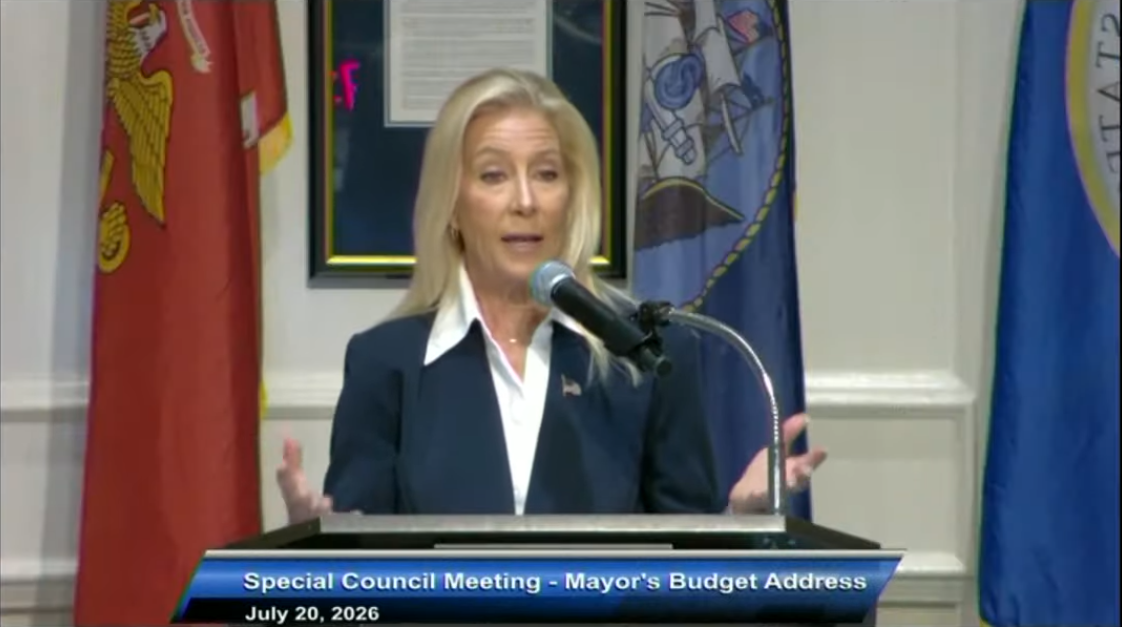
Jacksonville Mayor Donna Deegan will face a battle for re-election next year, but she’s got what she calls a “world-class city budget” to get passed before that, one backdropped by a constitutional amendment that could put serious constraints on Duval County’s property tax collections of nearly $1.3 billion starting in 2027.
Deegan’s fourth budget comes in at just over $2 billion, a 1.1% increase from the current fiscal year, driven by pay raises for first responders. All told, more than $1.07 billion will be spent on police and fire.
The Mayor spoke to affordability issues affecting citizens and said the same “must be true for city government.”
“Taxpayers do not owe government the benefit of the doubt. We owe taxpayers proof. Proof that we know the money is not ours, proof that we will not spend it simply because it’s available, proof that each dollar invested delivers a positive return for our citizens. In our analysis of the economic value generated by city services, each tax dollar provides nearly $3 in return,” Deegan said.
“With that in mind, every spending decision is geared to make Jacksonville more affordable.”
Deegan noted strong credit ratings from Fitch, S&P Global and KBRA, showing the city is “financially strong and getting stronger.” She said the ratings were “savings for taxpayers” that reassure investors, businesses and families.
The budget includes $36 million in road resurfacing proposed for the next fiscal year, $12 million into new and repaired sidewalks, and $25 million for septic tank phaseout and stormwater projects.
“These are not luxuries,” she said. “These are the bones of our city.”
Deegan also promised to continue “rightsizing” the capital improvement plan, which is more than $586 million in the new budget.
“We will resist the temptation to pretend every good idea can be funded immediately,” she said.

Deegan is proposing $27 million of new spending for the Museum of Science and History, along with $25 million for Riverfront Park.
Deegan also touted funding for other priorities, including Journey Forward, “juvenile justice diversion efforts that deliver a ten-fold return in economic value”; Healthlink Jax, which is the city’s telehealth program that she argues gets nearly a 5x return on investment; and affordable housing spending, via $6.3 million for the Emergency Rental and Eviction Protection program and “an Affordable Housing Trust Fund that will now have more than $5.5 million in it to build more housing that’s affordable for lower income levels and to assist first-time home buyers.”
Deegan said the spending bolsters the city at large by shoring up citizens in crisis.
“Not every investment is personally used by every resident. But every responsible investment should return value to the whole city. And in this budget, they do.”
To that end, Public Service Grants and the Cultural Council are proposed to keep funding roughly flat year over year. One might expect these to be potential flashpoints with some conservatives on Council during the budget deliberations.
Deegan said she hoped “to challenge the way we talk about core government” and expand the definition beyond public safety and trash collection. She argued that “many programs that have been called discretionary are actually upstream core investments.”
City Council President Nick Howland hailed a “new spirit of cooperation” by way of introducing the Mayor, who expressed hope that “the next political season” would not unduly cloud the process. But she went on to tweak the right flank on the Council that might “confuse inaction with conservatism.”
Republican Matt Carlucci, a staunch ally of Deegan’s, lauded the budget presentation as her best yet.
Democrat Ju’Coby Pittman credited Deegan with increasing the septic tank budget to address the “broken promises” of consolidation.
Republican Ken Amaro, a former colleague of Deegan’s in television news, praised the Mayor for addressing deferred maintenance, saying it’s “cowardice” to pretend those obligations can be ignored.