
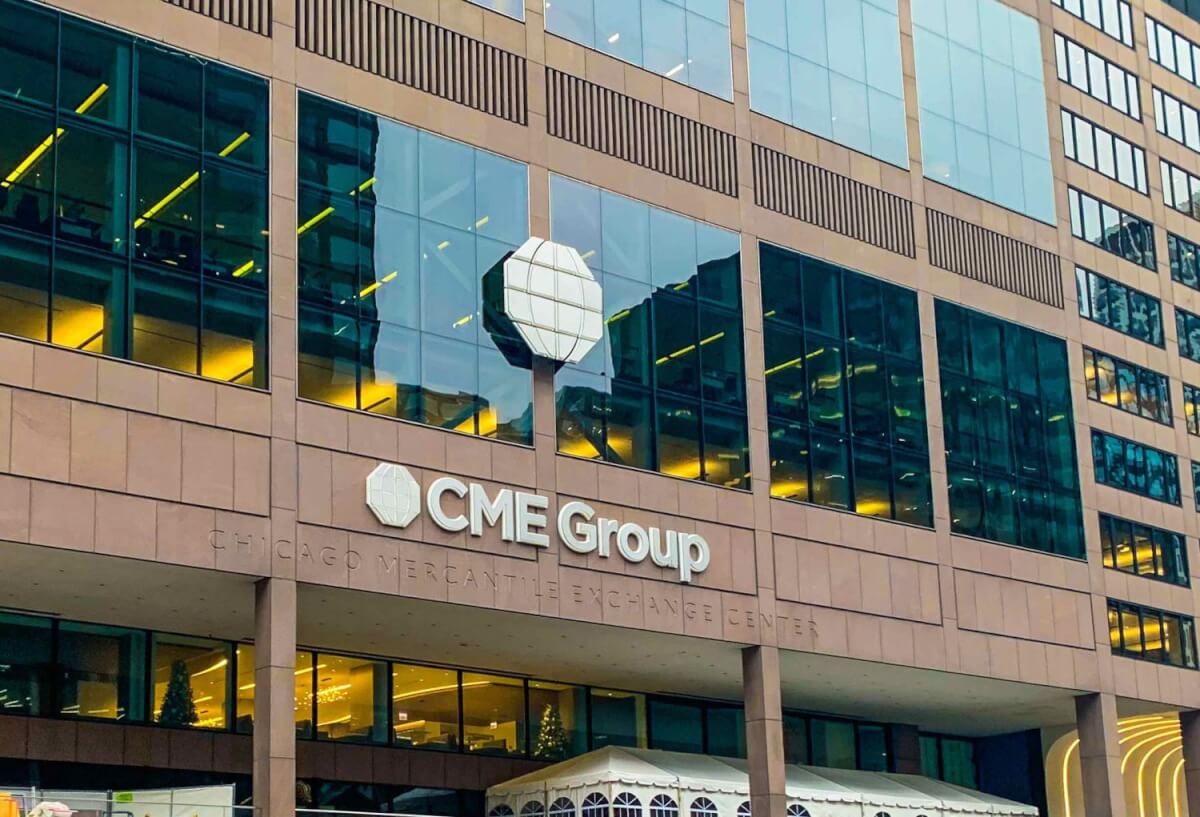
CME Group has launched Bitcoin Volatility Index futures, adding a new institutional trading instrument that allows investors to trade bitcoin volatility directly without taking exposure to bitcoin’s price direction.
The launch marks another step in the rapid institutionalization of crypto derivatives markets as exchanges increasingly build infrastructure resembling traditional equity, rates, and commodities markets.
First trades were executed as block transactions between DV Chain and Monarq Asset Management, according to CME Group.
The contracts arrive during a period of explosive growth in institutional crypto trading, expanding ETF participation, rising derivatives volumes, and growing demand for more sophisticated risk-management products.
Bitcoin Volatility Becomes A Standalone Asset Class
The new contracts are tied to CME Group’s Bitcoin Volatility Index, allowing traders to express views specifically on expected volatility rather than bitcoin price direction itself.
That distinction matters because volatility increasingly functions as its own tradable asset class across institutional finance.
In traditional markets, products tied to volatility indexes such as the VIX became widely used for hedging, macro positioning, tail-risk protection, and volatility arbitrage strategies.
Crypto markets historically lacked equivalent regulated infrastructure.
Institutional investors trading bitcoin volatility previously relied primarily on options structures, offshore perpetual swaps, OTC derivatives, or unregulated crypto venues.
CME’s new product instead provides regulated exchange-traded exposure to bitcoin volatility itself.
Giovanni Vicioso, Global Head of Cryptocurrency Products at CME Group, said the contracts respond to growing institutional demand for advanced crypto risk-management tools.
“The early support we’ve seen for our new Bitcoin Volatility futures further demonstrates the growing client demand for more innovative tools to more efficiently protect against adverse market moves,” Vicioso said.
He added, “Our new 24/7 trading framework expands the utility of these contracts, allowing investors to isolate and precisely manage their portfolio’s volatility risk and exposure at any hour of the day, any day of the week – unlocking a critical new layer of risk management.”
The launch is strategically important because volatility products tend to emerge only after markets reach a certain level of institutional maturity.
Equity volatility derivatives expanded after institutional portfolio hedging became widespread. Interest-rate volatility products developed alongside more complex fixed-income markets. Commodity volatility markets grew as institutional commodity participation increased.
The same pattern increasingly appears inside crypto.
Bitcoin spot ETFs, institutional custody, prime brokerage, regulated options markets, and futures clearing infrastructure all expanded significantly over the past two years.
The introduction of dedicated volatility futures suggests crypto derivatives markets are now evolving beyond directional speculation toward institutional portfolio management and volatility trading strategies.
CME’s Crypto Expansion Accelerates
The volatility futures launch also forms part of a much larger expansion in CME’s cryptocurrency business.
CME said its cryptocurrency product suite recorded average daily volume of 266,900 contracts year to date, up 38 percent year over year. Average daily open interest reached 274,500 contracts, rising 18 percent year over year.
The exchange also recently launched 24/7 crypto derivatives trading on May 29, reflecting growing pressure to align traditional exchange infrastructure with continuous crypto-market activity.
The shift matters because institutional crypto trading increasingly operates on a global and near-continuous basis.
Crypto-native venues normalized round-the-clock trading years ago. Traditional exchanges and clearinghouses are now gradually adapting their infrastructure to compete.
CME’s move into 24/7 crypto derivatives also reflects broader market structure changes happening across financial markets.
Nasdaq, NYSE, Interactive Brokers, Robinhood, and Charles Schwab all continue expanding overnight or extended-hours trading capabilities across different asset classes.
Institutional participants increasingly want constant access to risk management, collateral adjustments, and volatility hedging during macro events occurring outside traditional US market hours.
Bitcoin volatility products fit directly into that environment because crypto markets frequently experience sharp price swings during weekends, overnight macro events, ETF flows, geopolitical developments, and global liquidity shocks.
Shiliang Tang, CEO of Monarq Asset Management, said the contracts reflect bitcoin’s growing institutional maturity.
“As bitcoin continues to mature into a more mainstream institutional asset class, the demand for sophisticated risk management instruments grows alongside it,” Tang said. “Robust tools like CME Group Bitcoin Volatility futures are exactly what investors need to accurately express their market viewpoints and efficiently hedge their portfolios within a secure, transparent framework.”
Volatility trading itself may also become a growing institutional strategy inside crypto markets.
Many hedge funds, proprietary trading firms, and quantitative market makers increasingly trade implied volatility, volatility dispersion, volatility skew, and relative-value structures across traditional markets.
Regulated bitcoin volatility futures could expand those strategies into crypto markets at larger scale.
Crypto Markets Increasingly Resemble Traditional Financial Markets
The launch highlights how crypto market infrastructure increasingly converges with traditional finance.
Over the past decade, crypto trading evolved from largely unregulated spot exchanges into a market with futures clearinghouses, ETF issuers, custody banks, options markets, prime brokers, repo-style collateral systems, and regulated derivatives infrastructure.
CME increasingly sits at the center of that institutional transition.
The exchange already dominates regulated bitcoin and ether futures trading in the United States and has become a major venue for institutional crypto price discovery.
Open interest and volume growth also suggest institutional participation continues expanding despite periodic volatility and regulatory uncertainty.
Dave Vizsoly, CEO and Head Trader at DV Chain, said volatility trading represents a critical evolution for institutional crypto markets.
“As institutions increasingly seek advanced strategies to navigate today’s markets, the ability to trade pure volatility independent of price direction on a regulated platform is a critical evolution for both our clients and the broader marketplace,” Vizsoly said.
The broader implication is that crypto markets increasingly operate less like isolated speculative ecosystems and more like extensions of global macro markets.
Institutional investors now require the same tools they use elsewhere in finance:
- volatility hedging
- cross-asset collateral
- 24-hour access
- regulated clearing
- portfolio margining
- institutional custody
- basis trading
- systematic derivatives strategies
Bitcoin volatility futures therefore matter not only because of the contracts themselves but because of what they signal about crypto’s evolution.
Crypto markets increasingly appear to be entering the same infrastructure cycle previously seen across equities, commodities, and rates markets: spot trading first, derivatives second, then volatility and institutional risk-transfer products afterward.
Sources And Further Reading:
Takeaway
CME’s Bitcoin Volatility futures launch shows crypto derivatives markets are evolving beyond directional speculation toward institutional portfolio management and volatility trading. The introduction of regulated volatility products suggests bitcoin increasingly behaves like a mature macro asset class requiring the same risk-transfer infrastructure found in equities, rates, and commodities markets.